
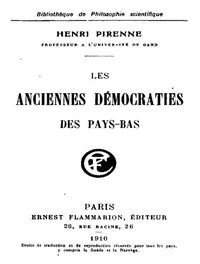
Les anciennes démocraties des Pays-Bas by Henri Pirenne
Henri Pirenne’s Les anciennes démocraties des Pays-Bas isn't a novel with a plot, but it tells a gripping story all the same. It’s the story of how people built freedom from the ground up.
The Story
Pirenne looks at the Low Countries—what we now call Belgium and the Netherlands—from about the 11th to the 16th centuries. While kings and emperors fought over land, something remarkable was happening in the cities. Places like Ghent, Bruges, and Ypres grew incredibly rich from the wool and cloth trade. This new wealth created a powerful class of merchants and skilled artisans. They didn't want to be ruled from afar by a distant lord. So, they fought for and won charters—legal agreements that gave them the right to govern themselves. They formed guilds, elected city councils, and created local militias. Pirenne traces how these urban communities managed their own justice, taxes, and defense, creating a practical, messy, and often conflicted form of democracy long before it became a national ideal.
Why You Should Read It
This book changed how I see history. We often learn about democracy starting with ancient Athens, then skipping ahead to 1776 or 1789. Pirenne puts a crucial, overlooked chapter in between. He makes you see that our modern freedoms have deep, medieval roots in commerce and community, not just in philosophical ideas. His writing, even in translation, has a clear, persuasive force. He makes old tax records and legal disputes feel urgent and human. You get a real sense of the noise, ambition, and stubborn pride of these city-dwellers who valued their independence above all else.
Final Verdict
This is a book for the curious reader who loves history but is tired of the same old stories of kings and battles. It’s perfect for anyone interested in politics, urban life, or economics who wants to understand the long, slow birth of the modern world. Be warned: it’s a serious academic work, not a light read. But if you stick with it, you’ll be rewarded with a powerful new perspective. You’ll never look at a medieval city square or a modern town hall the same way again.
This work has been identified as being free of known copyright restrictions. Feel free to use it for personal or commercial purposes.
Jessica Wilson
1 year agoNot bad at all.
Nancy Moore
1 year agoAmazing book.
Robert Martin
1 year agoSimply put, it manages to explain difficult concepts in plain English. Absolutely essential reading.
Richard Ramirez
9 months agoI have to admit, the arguments are well-supported by credible references. I will read more from this author.

Emily Thompson
7 months agoFast paced, good book.