
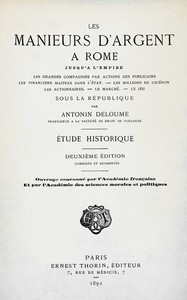
Les manieurs d'argent à Rome jusqu'à l'Empire by Antonin Deloume
Published in the late 19th century, Antonin Deloume's Les manieurs d'argent à Rome jusqu'à l'Empire (The Money Handlers of Rome up to the Empire) isn't a novel with a plot in the traditional sense. Instead, it's a detailed historical investigation. But its narrative is the rise of financial power itself.
The Story
Deloume traces the evolution of Roman finance from the early Republic to the dawn of the Empire. He starts with simple farming debts and shows how, as Rome conquered the Mediterranean, its financial needs exploded. We meet the publicani (tax collectors), who bid for the right to gather taxes from provinces, often squeezing them dry. We see senators, legally barred from direct commerce, using agents and freedmen to build massive fortunes through loans and state contracts. The book follows the money through major events: funding armies during the Punic Wars, the political chaos caused by widespread citizen debt, and the colossal fortunes of men like Crassus, who famously said an empire needed to be rich before it could be powerful. The climax of this 'story' is how this unchecked financial power, entangled with politics, created instability that contributed to the Republic's fall.
Why You Should Read It
What makes this old book compelling is its eerie relevance. Reading about Roman senators complaining about 'big money' corrupting politics, or about financial crises sparked by bad debt, feels less like history and more like commentary. Deloume doesn't just list facts; he connects dots. He shows how a law to curb debt could spark a social crisis, or how financing a war could make a banker more powerful than a general. The characters here aren't fleshed-out novel personas, but the systems and the shadowy figures operating them become fascinating protagonists in their own right. It reframes your understanding of Roman history. The battles were decided not just on the field, but in the accounting houses of the Forum.
Final Verdict
This is not a light, popular history. The writing is academic for its time, and it assumes some basic knowledge of Roman history. It's perfect for history buffs who want to look beyond kings and battles, for economics students curious about ancient systems, or for anyone who enjoys seeing the timeless patterns of power and money. If you liked the political intrigue of I, Claudius but always wondered about the 'how did they pay for it' angle, Deloume provides the serious, scholarly answer. It’s a niche, insightful read that proves the adage: follow the money.
This work has been identified as being free of known copyright restrictions. Access is open to everyone around the world.
Ava Ramirez
1 year agoSimply put, the depth of research presented here is truly commendable. Don't hesitate to start reading.
Jessica Perez
1 year agoWithout a doubt, the character development leaves a lasting impact. One of the best books I've read this year.
Donna Robinson
11 months agoSurprisingly enough, the character development leaves a lasting impact. A valuable addition to my collection.
Charles Wright
9 months agoThis book was worth my time since the storytelling feels authentic and emotionally grounded. Absolutely essential reading.










Emma Lewis
7 months agoAfter finishing this book, the plot twists are genuinely surprising. Highly recommended.