
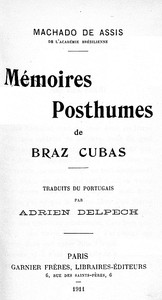
Mémoires Posthumes de Braz Cubas by Machado de Assis
Okay, let's talk about this strange and wonderful book. First published in 1881, it feels like it could have been written yesterday. Machado de Assis, a brilliant Brazilian writer, decided to turn the novel on its head a century before it was cool.
The Story
The book is the autobiography of Brás Cubas, a rich and somewhat lazy man from Rio de Janeiro. The catch? He's writing it after he's died. He recounts his life from childhood to his death from pneumonia, but he skips around in time, following his memories instead of a straight line. We see his spoiled youth, his obsession with a married woman named Virgília (his great, but impossible, love), his dabbling in politics, and his lifelong project to invent a 'Brás Cubas' plaster to cure melancholy. None of it really amounts to much. His love affairs fizzle, his political career is a joke, and his grand invention is a flop. The plot isn't about big events; it's about a man looking at the sum of his days and calling it a draw.
Why You Should Read It
I love this book because it's so honest and funny about human failure. Brás is not a hero. He's vain, self-centered, and often ridiculous. But Machado de Assis writes about him with such a sharp, knowing wit that you can't help but see bits of yourself in his flaws. The author constantly interrupts the story to chat with you, the reader. He'll say things like, 'Dear reader, let's skip this boring part,' or make a sarcastic comment about his own characters. It breaks all the rules and it's hilarious. Underneath the jokes, though, are big questions. What makes a life successful? Is happiness even the point? Brás ends up calling himself a 'small winner' not because of what he achieved, but because he didn't pass his melancholy on to anyone else. It's a darkly comic, surprisingly moving way to look at things.
Final Verdict
This book is perfect for anyone tired of straightforward, sentimental classics. If you enjoy dark humor, clever narration, and stories that question everything, you'll find a friend in Machado de Assis. It's also a great pick for readers who want to explore world literature beyond the usual European canon. Don't let the 19th-century publication date fool you—the voice in this book is fresh, witty, and waiting to surprise you.
You are viewing a work that belongs to the global public domain. You are welcome to share this with anyone.
Matthew Anderson
11 months agoI had low expectations initially, however it creates a vivid world that you simply do not want to leave. Highly recommended.








Elizabeth Lopez
1 year agoGreat read!