
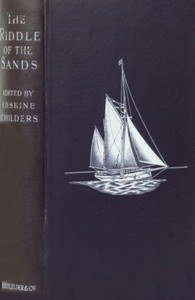
The Riddle of the Sands by Erskine Childers
Published in 1903, The Riddle of the Sands feels like it was written yesterday in its ability to build nail-biting suspense from the ground up. It’s often called the first great modern spy novel, but forget fancy gadgets and suave agents. This is espionage born from mud, tide charts, and gut instinct.
The Story
The story is told by Carruthers, a bored young civil servant in London. He’s invited on a late-season sailing trip in the Baltic by his friend, Arthur Davies. Davies is a different sort—practical, obsessed with his small boat, the Dulcibella, and deeply suspicious of the German yachtsmen he keeps encountering in the lonely shallows off the German coast. At first, Carruthers thinks Davies is just being paranoid. But as they navigate the maze-like channels and vast sandbanks, dodging patrols and piecing together clues, they uncover a chilling possibility: the Germans are practicing for a secret naval invasion of England, using the very sands that hide their boat. It becomes a desperate race to prove their theory and get a warning home before they’re discovered.
Why You Should Read It
What makes this book special isn't a twisty plot, but the thick atmosphere. Childers was a sailor himself, and his love for the sea—and fear of its hidden dangers—soaks every page. You feel the chill of the fog, the strain of pulling a boat off a sandbar, and the eerie silence of the empty wetlands. The friendship between the cautious Carruthers and the driven Davies feels real and grounded. Their fear isn't for queen and country in a grand way, but a very personal, immediate terror of being caught in a remote place where no one can help them. It’s a story that argues that sometimes, the most important discoveries are made by amateurs who are simply paying close attention.
Final Verdict
This is the perfect book for anyone who loves a slow-building, atmospheric thriller. If you enjoy stories where the setting is a central character—think remote islands or harsh wilderness—you’ll be right at home. It’s also a fascinating read for history fans, offering a snapshot of the simmering tensions in Europe before World War I. Just be prepared: you might start looking at your next beach vacation a little differently. A classic that genuinely earns the title.
There are no legal restrictions on this material. Enjoy reading and sharing without restrictions.
Andrew Miller
1 year agoVery helpful, thanks.
Nancy Brown
9 months agoI have to admit, the storytelling feels authentic and emotionally grounded. Thanks for sharing this review.
Betty Hill
2 years agoLoved it.
Elizabeth Thompson
1 year agoRecommended.









Charles Lewis
1 year agoBased on the summary, I decided to read it and the character development leaves a lasting impact. Definitely a 5-star read.