
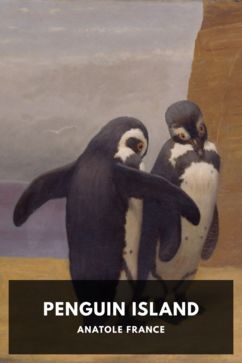
Penguin Island - Anatole France
Okay, let's set the scene. An elderly, near-sighted monk named Saint Mael lands on an Arctic island full of penguins. In a holy mix-up, he mistakes the dignified birds for a primitive people and baptizes them all. Heaven is faced with a celestial paperwork nightmare and decides the only solution is to turn the penguins into humans to validate the sacrament. And so, the nation of Penguinia is born.
The Story
The book is presented as a sweeping, mock-serious history of this new civilization. We watch as the former birds grapple with their sudden humanity. They immediately start bickering over territory, leading to the first war—sparked by a dispute over a field of turnips. From there, France takes us on a whirlwind tour through Penguinia's evolution, parodying the major epochs of French and European history. We see the age of chivalry (full of vain and brutal knights), the rise of capitalism and industry (where greed is the new religion), and even a version of the Dreyfus Affair, a major political scandal of France's own time. The narrative is less about individual characters and more about the society itself, which lurches from one foolish crisis to the next with a solemn self-importance that's completely hilarious.
Why You Should Read It
What makes this book stick with you is how it balances sheer silliness with genuine insight. France has this incredible ability to point out the absurdities of human institutions—government, religion, law, war—without ever feeling preachy. He just shows the penguins doing what we do, and you can't help but laugh in recognition. The satire is timeless because, sadly, human nature doesn't change much. We're still fighting wars over ancient grievances, getting tangled in bureaucracy, and convincing ourselves our way is the only right way. Reading this feels like getting a gentle, witty nudge from a very clever friend who's saying, 'Look at us. Aren't we ridiculous?'
Final Verdict
This is a perfect pick for anyone who enjoys smart humor with a historical or philosophical bent. If you like authors like Voltaire, Kurt Vonnegut, or Terry Pratchett, you'll find a kindred spirit in Anatole France. It's for readers who don't mind a book that makes them chuckle and then pause to think. Fair warning: it was written in 1908, so some references might fly over your head, but the core jokes about power, pride, and progress land perfectly. Don't go in expecting a fast-paced novel; think of it as a series of brilliantly connected, satirical sketches from the world's weirdest history textbook.
This content is free to share and distribute. Access is open to everyone around the world.
Thomas Clark
8 months agoHaving read this twice, the emotional weight of the story is balanced perfectly. Don't hesitate to start reading.
Thomas King
7 months agoClear and concise.
Amanda Harris
8 months agoSolid story.








Richard Jackson
3 months agoThe analytical framework presented is both innovative and robust.