About 290 minutes
Captain Mugford: Our Salt and Fresh Water Tutors — Themes and Context
Sea Voyages Pirate Adventures
66,619 recorded words. 6 minutes difference from this book's estimate.
View Gutenberg source #21453
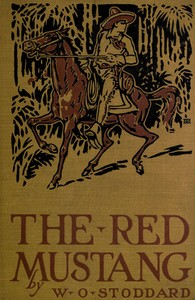
For The Red Mustang — Key Ideas to Explore, the stored edition analysis reports 65,284 words, 4 hr 44 min estimated reading time, and 9 detected text sections.
The text analysis averages about 18.2 words per sentence, while the detected sections provide another way to judge how the source is divided.
Project Gutenberg metadata also associates the work with “Conduct of life -- Juvenile fiction,” connecting these edition facts with the source record’s subject description.
Explore this collection
These alternatives are selected using recorded categories and estimated reading time.
About 290 minutes
Sea Voyages Pirate Adventures
66,619 recorded words. 6 minutes difference from this book's estimate.
View Gutenberg source #21453About 268 minutes
Sea Voyages Pirate Adventures
61,462 recorded words. 16 minutes difference from this book's estimate.
View Gutenberg source #23725About 343 minutes
Sea Voyages Pirate Adventures
78,720 recorded words. 59 minutes difference from this book's estimate.
View Gutenberg source #21239Search stored excerpts and compare books → Choose by your preferences →
Choices use stored catalog measurements. Estimates vary with reading speed. A shared category is a catalog label, not a claim that two books have the same argument or literary quality.
Search reads excerpt text stored with this catalog and links to its associated Gutenberg record. The connection is stored in the site database; this tool does not recheck that every excerpt is word-for-word identical to that external record. Excerpt search does not cover every chapter and does not verify historical publication dates.
Catalog snapshot checked: 2026-09-25. Coverage: 92 public books, 92 available source excerpts.
Read the complete public-domain text at its original source.
Read on Project GutenbergThe first chapter, 'The Horse and His Rider,' opens on a June morning with a knoll in southern New Mexico occupied 'as it had never been before.' The narrative quickly centers on Cal Evans and his red mustang, establishing a direct, action-oriented voice. The catalog subjects—horses, Indians, soldiers, cowboys—are all present from the start, but the text focuses on the physical relationship between boy and horse rather than exposition. The opening sets a pattern of swift movement and immediate stakes.
The middle excerpts reveal a layered conflict. Apache chief Kah-go-mish orchestrates a trap for Colonel Romero's Mexican soldiers, using a false trail of 'trampled sand, so well marked by dragged lodge-poles.' The Mexicans follow it into a dead end at the chaparral's edge. Stoddard builds tension through parallel perspectives: the soldiers' council, where they convince themselves to press on, and the Apache boy who gallops back to report success. The phrase 'Where Mexicans gone?' recurs as a puzzle, showing how the narrative withholds information from one group while granting it to another. This structural choice—alternating between pursuer and pursued—creates a cat-and-mouse rhythm that a first reader can track across the early chapters.
After the trap succeeds, the story shifts to the Apache camp. Wah-wah-o-be, mother of Ping and Tah-nu-nu, reacts with despair: 'The light of her life seemed to have departed.' She fears her children will be 'turned into something different from their noble father and mother.' Stoddard uses her blanket-over-the-head gesture to convey grief without melodrama. Meanwhile, Kah-go-mish calculates his next moves, valuing 'all the horses of the band at only a fraction of what they had seemed to be worth.' The contrast between maternal anguish and strategic planning gives the Apache characters distinct interior lives. A first reader notices that the narrative does not villainize them; instead, it presents their motives as understandable, even sympathetic, within the story's moral framework.
Later chapters narrow to Cal's isolation. Chapter titles like 'Cal's Night Under a Tree' and 'How Cal Was Left All Alone' signal a survival arc. The red mustang, introduced as a mount, becomes a rescuer in the final chapter: 'Rescued by the Red Mustang.' The excerpts show Cal using a knife as a pen on a leaf, a detail that underscores resourcefulness. The landscape—chaparral, desert, Cold Spring—functions as both obstacle and character. Stoddard's prose remains lean, favoring action over introspection. A first reader observing this pattern can anticipate that the mustang is not merely a vehicle but a narrative linchpin, its return likely coinciding with Cal's moment of greatest need.
The book's serial origins (Harper's Young People's Series) shape its voice. Each chapter ends with a hook: 'How Cal Started for Mexico' or 'The Mystery of the Sticks.' The prose is declarative, with short paragraphs and frequent exclamations like 'Now for Santa Lucia!' The narrator addresses the reader directly at times, a convention of 19th-century juvenile fiction. The vocabulary is accessible but not simplistic; words like 'chaparral' and 'cougar' are used without gloss. A first reader benefits from noting the chapter titles as signposts—they often summarize the action to come, reducing confusion about plot direction. The brisk pacing and clear moral distinctions (loyalty, courage, cunning) align with the catalog subject 'Conduct of life.'
Reading The Red Mustang sequentially rewards attention to its alternating viewpoints. The early chapters shift between Cal, the Apaches, and the Mexican soldiers, each with distinct goals. Later, the focus narrows to Cal's solitary ordeal. The red mustang itself is a constant, its presence or absence marking turning points. A first reader should watch how Stoddard uses landscape—the chaparral, the desert spring—to create both obstacle and refuge, and how the title animal ultimately bridges the story's separate threads.
There’s something about Cal’s quiet bond with that mustang that lingers—how a shared silence can be its own kind of language. It reminds me of the gentler rhythms I found in Aunt Hannah and Seth — Edition Insights, where the spaces between words matter just as much. Some stories simply feel like old friends, even on first meeting.
Answer a few questions and save a private reflection on this device.