About 332 minutes
Facing Death; Or, The Hero of the Vaughan Pit: A Tale of the Coal Mines — Themes and Context
Fantasy Juvenile Worlds
76,179 recorded words. 3 minutes difference from this book's estimate.
View Gutenberg source #31128
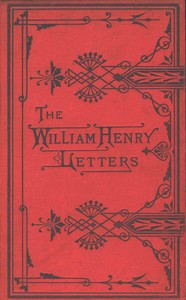
The source record for The William Henry Letters — Edition Insights measures this digital text at 76,993 words, 5 hr 35 min estimated reading time, and 9 detected text sections.
The text analysis averages about 14.9 words per sentence, while the detected sections provide another way to judge how the source is divided.
Project Gutenberg metadata also associates the work with “Conduct of life -- Juvenile fiction,” connecting these edition facts with the source record’s subject description.
Explore this collection
These alternatives are selected using recorded categories and estimated reading time.
About 332 minutes
Fantasy Juvenile Worlds
76,179 recorded words. 3 minutes difference from this book's estimate.
View Gutenberg source #31128About 331 minutes
Fantasy Juvenile Worlds
76,028 recorded words. 4 minutes difference from this book's estimate.
View Gutenberg source #33242About 327 minutes
Fantasy Juvenile Worlds
75,169 recorded words. 8 minutes difference from this book's estimate.
View Gutenberg source #21664Search stored excerpts and compare books → Choose by your preferences →
Choices use stored catalog measurements. Estimates vary with reading speed. A shared category is a catalog label, not a claim that two books have the same argument or literary quality.
Search reads excerpt text stored with this catalog and links to its associated Gutenberg record. The connection is stored in the site database; this tool does not recheck that every excerpt is word-for-word identical to that external record. Excerpt search does not cover every chapter and does not verify historical publication dates.
Catalog snapshot checked: 2026-09-25. Coverage: 92 public books, 92 available source excerpts.
Read the complete public-domain text at its original source.
Read on Project GutenbergThe William Henry Letters presents itself as a collection of correspondence edited by a neighbor who, in the introduction, describes his acquaintance with the families at "Summer Sweeting place." The editor's voice is notably self-deprecating: he admits he was chosen not for talent but for "intimate acquaintance" with the households. This framing establishes a domestic, observational tone. The excerpts show William Henry's letters brimming with detailed accounts of school life—charades, treats, and teachers who "like to play with boys." His language is colloquial and exuberant, as when he describes a floating island dessert as "a floating continent!" The editor's own narrative, meanwhile, reveals a parallel interest in Freedmen's aid, hinting at a broader social awareness that contrasts with the boy's narrower world.
The editor introduces himself as a man who rashly promised to collect old clothing for Freedmen's societies, a task that leads him to encounter the families. He is not a professional writer; he emphasizes his lack of "talents" and "learning." This modesty shapes the book's tone: the letters are presented as authentic artifacts, not polished fiction. The editor's involvement with the Freedmen—having served in the Army of the Potomac and worked in a Washington hospital—places the story in a post-Civil War context. Yet the letters themselves focus on schoolyard antics and family visits, creating a quiet tension between the editor's adult concerns and William Henry's childhood preoccupations.
William Henry's letters are marked by breathless enthusiasm and concrete detail. He describes a school charade where passengers jerk "up in a heap together" to mimic a train, and he marvels at ice creams shaped "into pyramids and rabbits." His affection for his teacher is clear: "O, if he isn't a tiptop teacher!" The boy's voice is earnest and unguarded, often addressing his grandmother directly. He promises to "study hard if I possibly can," revealing a desire to please. The excerpts also show his family network—grandmother, Aunt Phebe, and others—suggesting a close-knit domestic circle. The editor occasionally interjects with observations about the families, but the letters remain the primary source of William Henry's perspective.
The charade included in the excerpts is a detailed script for a skit titled "Carpet," with passengers entering a train car. The instructions are precise: a "fat woman" with bundles, a "dandy" with a "slender cane," and a "lady with infant" carrying a "very large rag-baby." The performance requires coordinated motion—"the jerking, up-and-down motion peculiar to the cars"—and ends with a shout of "All aboard!" This theatrical interlude mirrors the performative quality of the letters themselves, where William Henry often stages his experiences for his family. The charade also reflects the book's interest in social types and humorous observation, a pattern that likely recurs throughout the correspondence.
The editor's introduction and the letters occupy different emotional registers. The editor writes of war, hospitals, and "hungry and sick" Freedmen; William Henry writes of candy, charades, and missing lessons. This juxtaposition is not resolved in the excerpts—the editor does not impose his worldview on the boy's letters. Instead, the two voices coexist, with the editor occasionally noting his own limitations. The effect is a layered narrative: one layer is the child's immediate, joyful world, and the other is the adult's reflective, socially aware framing. Readers may find interest in how these layers interact, especially as the editor claims only to "collect and arrange" the letters.
Readers approaching The William Henry Letters should attend to the interplay between the editor's framing and the boy's voice. The editor's involvement with Freedmen's aid and his self-effacing tone provide a quiet counterpoint to William Henry's exuberance. The letters themselves reward attention to their specific details—the charades, the treats, the affectionate descriptions of teachers and family. This is not a book that announces its themes; rather, it invites readers to piece together the world of Summer Sweeting place from the fragments the editor has preserved.
Reading The William Henry Letters, I kept thinking how much letters capture a boy’s private flutter of belonging. The editor’s gentle framing felt like someone holding a faded photograph. That same tenderness lingered when I later opened Girls of the Forest — Story, Setting & Ideas, where the woods hold their own quiet epistles of growing up.
Your answers remain private and are stored only in this browser.