About 302 minutes
The Wide Awake Girls in Winsted — Text and Context
Fantasy Juvenile Worlds
69,302 recorded words. 8 minutes difference from this book's estimate.
View Gutenberg source #31200
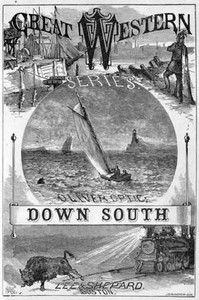
The source record for Down South; or, Yacht Adventure in Florida — Text and Context measures this digital text at 67,522 words, 4 hr 54 min estimated reading time, and 8 detected text sections.
The text analysis averages about 17.2 words per sentence, while the detected sections provide another way to judge how the source is divided.
Project Gutenberg metadata also associates the work with “Animals -- Juvenile fiction,” connecting these edition facts with the source record’s subject description.
Explore this collection
These alternatives are selected using recorded categories and estimated reading time.
About 302 minutes
Fantasy Juvenile Worlds
69,302 recorded words. 8 minutes difference from this book's estimate.
View Gutenberg source #31200About 281 minutes
Fantasy Juvenile Worlds
64,536 recorded words. 13 minutes difference from this book's estimate.
View Gutenberg source #25466About 280 minutes
Fantasy Juvenile Worlds
64,221 recorded words. 14 minutes difference from this book's estimate.
View Gutenberg source #23627Search stored excerpts and compare books → Choose by your preferences →
Choices use stored catalog measurements. Estimates vary with reading speed. A shared category is a catalog label, not a claim that two books have the same argument or literary quality.
Search reads excerpt text stored with this catalog and links to its associated Gutenberg record. The connection is stored in the site database; this tool does not recheck that every excerpt is word-for-word identical to that external record. Excerpt search does not cover every chapter and does not verify historical publication dates.
Catalog snapshot checked: 2026-09-25. Coverage: 92 public books, 92 available source excerpts.
Read the complete public-domain text at its original source.
Read on Project GutenbergOliver Optic's Down South; or, Yacht Adventure in Florida (1880) opens its narrative aboard the steamer Sylvania, where Captain Garningham commands a mixed company of Western and Southern characters. The excerpted passage centers on a violent confrontation: the octoroon steward Griffin Leeds draws a bowie knife on Ben Bowman, a passenger, after waking from a dream of assault. The captain's swift, authoritative response—ordering Griffin tied and handed to police—reveals a narrative voice that prizes decisive action and moral clarity. Optic's prose moves briskly between dialogue and command, with the captain's internal debate over leniency adding a layer of psychological tension. The scene also introduces Cornwood, a Floridian who pleads for the steward, hinting at regional sympathies that may complicate the hero's straightforward sense of justice.
Captain Garningham speaks in short, declarative sentences that project unhesitating authority: “We don't allow brawls on board this steamer.” His internal monologue, however, reveals a flicker of doubt—“I was afraid I might do so if he talked to me long in this strain”—suggesting a character who must consciously steel himself against compassion. Optic uses this tension to humanize the hero without undermining his resolve. The captain's reasoning is grounded in observable fact: he notes that Griffin drew the knife “at least five minutes after you were pinned to the deck,” rejecting the dream excuse as “too thin.” This emphasis on evidence over emotion aligns with the series' didactic strain, where right action follows from clear-eyed judgment.
The excerpt's dialogue does more than advance plot; it differentiates characters by register and intent. Griffin's speech shifts from frantic pleading (“I was mad, crazy with excitement”) to humble self-deprecation (“I never was before a court for anything”), a pattern that invites reader sympathy even as the captain remains unmoved. Cornwood, by contrast, uses formal, lawyerly phrases—“I beg you to consider that you are doing a very great injustice”—that mark him as a man of persuasion rather than action. Ben Bowman's interjection is defensive and literal: “I did not lay the weight of one hand on him.” Optic thus builds a small courtroom drama on deck, where each voice reveals a distinct moral posture.
Optic controls pace through alternating bursts of action and deliberation. The physical struggle—wrenching the knife, tying the prisoner—is rendered in rapid, clipped clauses: “Hold on to him a moment, Buck!” “Get some line, and tie him hand and foot!” Then the narrative slows for debate, as Cornwood pleads and the captain weighs his duty against the upcoming excursion. This rhythm of crisis and reflection recurs throughout the passage, creating a pattern that keeps the reader engaged while allowing moral questions to surface. The final shift to planning the up-river trip (“We leave on Monday”) returns the story to its adventure trajectory, but the unresolved tension over Griffin's fate lingers.
Readers approaching Down South should attend to how Optic balances the promised yacht adventures—hunting alligators, fishing, exploring Florida's rivers—with the interpersonal dramas that test the hero's principles. The excerpt suggests that even in a “sportsman's paradise,” moral decisions carry weight. The captain's voice, at once firm and introspective, anchors the narrative; watching how he navigates both the St. Johns and the demands of justice will reward those who read beyond the surface of adventure.
Reading about the steward’s knife and the tense quarters on that yacht, I remembered the cramped, hot summers of my own childhood, reading It in a porch hammock. That cat’s independent, wary watchfulness felt like the same unspoken hurt I sensed between characters here. Both books make me think about how silence can hold more than speech. It's like this, cat — Story, Setting & Ideas
Capture what you thought, learned, and would like to remember.