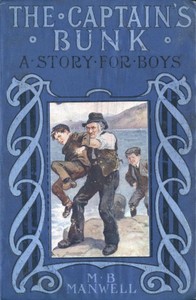
The opening pages of The Captain's Bunk establish a narrator who moves easily between affectionate observation and brisk moral commentary. The village of Northbourne is introduced with a simile that personifies its cottages—they have 'seated themselves, as it were, in a semicircle'—and the description of outward-bound liners as 'grey ghostly shadows' gives the setting a faintly melancholy grandeur. Yet within a paragraph the tone pivots to comic exasperation, as the vicarage terriers Splutters and Shutters are said to keep the household 'in bilin' water'. This quick shift from lyrical to colloquial is characteristic of the book's narrative strategy.
Voice and Moral Framing
The narrator frequently steps forward to deliver aphorisms—'life is real, life is earnest'—that frame the boys' rebellions within a didactic structure. These interjections are not seamless; they sometimes interrupt the flow of action, as when the tutor Philip Price's thoughts are summarised in a single italicised maxim. The effect is to remind the reader that the story carries a lesson, even as the prose lingers on the boys' 'frenzy' for bird-training. The moralising voice is most pronounced in chapter headings and transitions, where it can feel like a separate register from the lively dialogue and physical detail.
Dialect and Social Texture
Manwell uses dialect sparingly but pointedly. Binks, the handy-man, speaks in a broad vernacular—'They two dogs, they be summat like a couple o' wild b'ys'—that contrasts with the standard English of the narrator and the gentry. This linguistic divide reinforces the social hierarchy of Northbourne, where the Bunk and the Vicarage stare 'face to face' across the bay. The dialect is not merely decorative; it conveys character, as when Jerry Blunt's confidence is expressed in his reply, 'Yes; you bide a wee, Muster Alick!' The narrator does not translate or comment on these phrases, trusting the reader to infer meaning from context.
Pacing and the Rhythm of Rebellion
The narrative alternates between expansive, scene-setting passages and compressed moments of conflict. The description of the boys' 'extravagantly crazed' desire to join Jerry's bird-training enterprise builds slowly, then snaps into a 'furious meeting at the Bunk'. This pattern—accumulation of detail followed by abrupt confrontation—gives the domestic drama a rhythmic tension. Later, the picnic scene slows again, with Alick's scorn for 'rubbishy artificial formality' rendered in free indirect discourse that aligns the reader with his perspective. The pacing thus mirrors the boys' own swings between idyllic freedom and disciplinary consequence.
Readers attentive to narrative voice will notice how Manwell uses the terriers Splutters and Shutters as a comic foil for the human characters, their mischief prefiguring the boys' own 'mutiny'. The book's structure—alternating between the Bunk and the Vicarage—creates a spatial tension that mirrors its moral one. Pay particular attention to the way the narrator's tone changes when describing the sea versus the schoolroom; these shifts are the surest guide to the story's emotional landscape.
That rainy afternoon, The Captain's Bunk left me thinking about how a voice can shift—playful one moment, stern the next—until I noticed my own reading slowing to catch the cadence. Later, almost by accident, I picked up Marguerite de Valois — A Closer Reading and felt the same quiet tension between story and judgment, only rendered in older, stranger rooms.