About 92 minutes
The Hunter Cats of Connorloa — A Closer Reading
Fantasy Juvenile Worlds
21,110 recorded words. 4 minutes difference from this book's estimate.
View Gutenberg source #28385
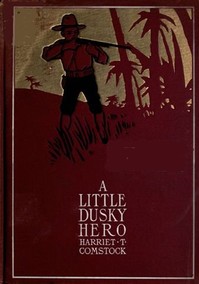
The catalog record for A Little Dusky Hero — Reading Notes provides practical reading context through 20,200 words, 1 hr 28 min estimated reading time, and 2 detected text sections.
The text analysis averages about 14.2 words per sentence, while the detected sections provide another way to judge how the source is divided.
Project Gutenberg metadata also associates the work with “Orphans -- Juvenile fiction,” connecting these edition facts with the source record’s subject description.
Explore this collection
These alternatives are selected using recorded categories and estimated reading time.
About 92 minutes
Fantasy Juvenile Worlds
21,110 recorded words. 4 minutes difference from this book's estimate.
View Gutenberg source #28385About 78 minutes
Fantasy Juvenile Worlds
17,767 recorded words. 10 minutes difference from this book's estimate.
View Gutenberg source #29594About 76 minutes
Fantasy Juvenile Worlds
17,352 recorded words. 12 minutes difference from this book's estimate.
View Gutenberg source #33372Search stored excerpts and compare books → Choose by your preferences →
Choices use stored catalog measurements. Estimates vary with reading speed. A shared category is a catalog label, not a claim that two books have the same argument or literary quality.
Search reads excerpt text stored with this catalog and links to its associated Gutenberg record. The connection is stored in the site database; this tool does not recheck that every excerpt is word-for-word identical to that external record. Excerpt search does not cover every chapter and does not verify historical publication dates.
Catalog snapshot checked: 2026-09-25. Coverage: 92 public books, 92 available source excerpts.
Read the complete public-domain text at its original source.
Read on Project GutenbergThe opening pages of A Little Dusky Hero introduce George Washington McKinley Jones through his own voice: a soft, droning “Good-mornin’, sah!” that merges with the buzz of flies and the scratch of a pen. The boy is described as “the very smallest, dirtiest, raggedest black boy” the Colonel has ever seen, yet his “beautiful great eyes” look up trustingly. His father is in prison for killing a friend; his mother died the day before. He comes to the Colonel because he likes the look of his face, he is hungry, and he wants work. The catalog subjects list orphans, conduct of life, friendship, kindness, the Spanish-American War, soldiers, African Americans, courage, heroes, and prejudices—but the excerpts focus less on moralizing and more on the boy’s specific circumstances and his dialect-rich speech.
The excerpts render George Washington McKinley Jones’s speech in a thick dialect: “Daddy he done got put in prison fur life, sah, ’cos he killed a frien’ of his, an’ my mammy she done died yesterday.” The narrator’s own voice is standard, but the boy’s lines carry the story’s emotional weight. When he later cries out, “I’se got de Colonel!” the phrase becomes a refrain. The dialect is consistent and unapologetic, marking G. W. as distinct from the white characters. It also serves to underline his vulnerability and his courage: the same voice that pipes a polite greeting also declares his intention to find his Colonel on the battlefield. The catalog subject “African Americans -- Juvenile fiction” is thus realized through a specific linguistic identity, not merely through presence.
In the chapter “The Colonel’s Body-Guard,” G. W. faces an internal battle. He has promised to stay on his hill-top, but he sees wounded men being brought to a tent below and fears his Colonel may be among them. The text dramatizes his conflict through personified voices: “Obey!” cries Honor; “But the Colonel may lie in the long row,” pleads Love. G. W. ultimately “gave up his promise” and runs down the forbidden side of the hill, “sobbing and crying.” He flings off his coat and cap, feeling the honor of a soldier’s uniform is no longer his. This moment is the emotional core of the excerpts: a child’s moral struggle rendered in concrete actions—removing his coat, crushing a letter into his shirt—rather than abstract lessons. The catalog subject “Courage -- Juvenile fiction” is here shown as a painful choice, not a simple virtue.
The story is anchored in the physical details of Tampa during the Spanish-American War: “the dead heat of Tampa hung heavy within the tent,” flies buzz, and a pen scratches across paper. Later, G. W. climbs a hill and looks down on a “big rude tent, with all sides open,” where wagons bring “burdens that turned poor little G. W. ill.” The description is stark: men are laid in long rows, and a man is “singled out from the lines and borne to the table.” The boy does not understand what he sees, repeating aloud, “I can’t—think—what—dat—means!” The setting is not a backdrop but an active force—heat, flies, and the gruesome sight of field surgery press on the character. The catalog subject “Spanish-American War, 1898 -- Juvenile fiction” is thus rendered through a child’s limited, visceral perspective, not through battle tactics or historical exposition.
Readers should attend to how the excerpts use repetition—of phrases like “Good-mornin’, sah!” and “I’se got de Colonel!”—to build rhythm and emotional emphasis. The story’s moral weight falls on G. W.’s choices, not on the war itself. The catalog subjects list “Prejudices -- Juvenile fiction,” but the excerpts do not explicitly address racial prejudice; instead, they show a white colonel accepting a Black boy’s service without comment. The full book may develop this theme further, but the excerpts leave it implicit.
I keep returning to the boy in A Little Dusky Hero, how he measured his worth in moments of danger. That quiet arithmetic of courage reminded me of another lonely child, one whose heroism was quieter still. There is a softness in that other tale, a gentler kind of proving. Just Gerry — A Reader’s Guide holds that same ache of wanting to be seen, though it never raises its voice. Just a memory, resting here.
Save your reaction, strongest insight, and memorable passage.