About 199 minutes
Miss Mouse and Her Boys — Background and Themes
Fantasy Juvenile Worlds
45,706 recorded words. 1 minutes difference from this book's estimate.
View Gutenberg source #30966
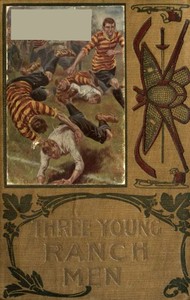
Three Young Ranchmen; or, Daring Adventures in the Great West — Background and Themes can be approached with a clearer sense of reading commitment from its source measurements: 45,434 words, 3 hr 18 min estimated reading time, and 5 detected text sections.
The text analysis averages about 13.2 words per sentence, while the detected sections provide another way to judge how the source is divided.
Project Gutenberg metadata also associates the work with “Orphans -- Juvenile fiction,” connecting these edition facts with the source record’s subject description.
Explore this collection
These alternatives are selected using recorded categories and estimated reading time.
About 199 minutes
Fantasy Juvenile Worlds
45,706 recorded words. 1 minutes difference from this book's estimate.
View Gutenberg source #30966About 203 minutes
Fantasy Juvenile Worlds
46,592 recorded words. 5 minutes difference from this book's estimate.
View Gutenberg source #23116About 203 minutes
Fantasy Juvenile Worlds
46,622 recorded words. 5 minutes difference from this book's estimate.
View Gutenberg source #34218Search stored excerpts and compare books → Choose by your preferences →
Choices use stored catalog measurements. Estimates vary with reading speed. A shared category is a catalog label, not a claim that two books have the same argument or literary quality.
Search reads excerpt text stored with this catalog and links to its associated Gutenberg record. The connection is stored in the site database; this tool does not recheck that every excerpt is word-for-word identical to that external record. Excerpt search does not cover every chapter and does not verify historical publication dates.
Catalog snapshot checked: 2026-09-25. Coverage: 92 public books, 92 available source excerpts.
Read the complete public-domain text at its original source.
Read on Project GutenbergThe opening chapter of Three Young Ranchmen immediately establishes a tone of self-reliance and peril. The three Winthrop brothers—Allen, Chetwood, and Paul—are introduced as orphans left to manage a remote Idaho ranch. The first excerpt shows them discovering a threat: horse thieves have been active nearby. The narrative wastes no time in plunging into action, with the boys arming themselves and setting out to investigate. The author, writing as Captain Ralph Bonehill, uses direct dialogue and swift pacing to convey the boys' determination and the dangers of their frontier life. The preface promises a story drawn "as true to nature as possible," and the opening delivers on that promise by grounding the adventure in specific, practical concerns—livestock, property, and survival.
The excerpts reveal that each brother has a distinct temperament and role within the group. Allen, the eldest, is the cautious strategist: he urges restraint and careful planning. Chetwood is more impulsive, quick to act and eager to confront danger. Paul serves as a mediator, balancing his brothers' tendencies. In the encounter at Dottery's barn, Chet is ready to fire at the horse thieves, but Paul warns, "Don't fire! Wait!" and later counsels against rash action. This dynamic recurs throughout the excerpts, creating a natural tension that drives the plot. The author uses their differing voices to advance the story without heavy exposition. Readers can track who is speaking by the style of command or caution each brother employs.
The horse thieves—Saul Mangle, Darry Nodley, and Jeff Jones—are the primary antagonists in the excerpts. They appear first as a rumor, then as a direct menace when the boys discover them raiding their neighbor Dottery's barn. The author builds suspense through the boys' stealthy approach and the darkness of the setting. Details such as the lantern light in the barn, the wire fence, and the "heavy log building" of Dottery's home ground the scene in a tangible landscape. The thieves are not fully characterized; they function as obstacles that test the boys' courage and resourcefulness. The excerpts show the brothers outnumbered but not outmatched, relying on teamwork and local knowledge to counter the threat.
Stratemeyer employs a classic serial technique: each chapter ends with a moment of heightened tension. The first chapter closes with the brothers discovering the thieves' tracks and deciding to pursue them. Later, a chapter ends with Chet and Paul spotting the thieves at Dottery's barn, and the next begins with them "hardly suppress[ing] their excitement" as the men move toward the fence. This structure encourages readers to continue, as each excerpt offers a new complication. The author also uses chapter titles as previews—"An Encounter in the Dark" signals a confrontation before it happens. For a first reading, these cliffhangers serve as natural stopping points and prompts to reflect on what might happen next.
The dialogue in the excerpts often contrasts the boys' integrity with the thieves' lawlessness. When Paul urges Chet not to shoot, he says, "Don't do anything rash," emphasizing caution over vengeance. Dottery, the neighbor, is described as an "old settler" who "rarely took the trouble to undress when he went to rest," implying a rugged, no-nonsense morality. In contrast, the thieves are shown only through their actions—leading horses away, fleeing in the dark. The author does not moralize explicitly; instead, the boys' decisions to alert Dottery rather than attack alone illustrate their sense of justice. This pattern of restraint versus recklessness recurs, giving readers a clear ethical framework without overt preaching.
As you read Three Young Ranchmen, pay attention to how the brothers' decisions reflect their individual characters and how the setting—Idaho's mountains and rivers—shapes the action. The excerpts offer only a glimpse of the full story, which includes a missing uncle, a grizzly bear, and a buffalo stampede. The author's method is to introduce a problem, escalate it through action and dialogue, and resolve it just enough to set up the next challenge. This structure rewards attentive reading and makes the book a model of early twentieth-century adventure serials.
There’s something comforting in how the ranchmen brothers face each scrape with quiet grit, and it reminds me of the gentler mischief in Leslie Ross; or, Fond of a Lark — Reading Companion—both worlds feel far away now. I sometimes miss that straightforward courage, where a cliffhanger just meant turning the page, not chasing the next alert.
Answer a few questions and save a private reflection on this device.