About 225 minutes
Rufus and Rose; Or, The Fortunes of Rough and Ready — A Closer Reading
Science Fiction Utopias
51,526 recorded words. 3 minutes difference from this book's estimate.
View Gutenberg source #25967
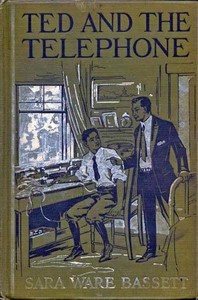
Ted and the Telephone — Inside the Classic can be approached with a clearer sense of reading commitment from its source measurements: 52,406 words, 3 hr 48 min estimated reading time, and 6 detected text sections.
The text analysis averages about 15.3 words per sentence, while the detected sections provide another way to judge how the source is divided.
Project Gutenberg metadata also associates the work with “People with disabilities -- Juvenile fiction,” connecting these edition facts with the source record’s subject description.
Explore this collection
These alternatives are selected using recorded categories and estimated reading time.
About 225 minutes
Science Fiction Utopias
51,526 recorded words. 3 minutes difference from this book's estimate.
View Gutenberg source #25967About 206 minutes
Science Fiction Utopias
47,260 recorded words. 22 minutes difference from this book's estimate.
View Gutenberg source #25053About 186 minutes
Science Fiction Utopias
42,664 recorded words. 42 minutes difference from this book's estimate.
View Gutenberg source #34591Search stored excerpts and compare books → Choose by your preferences →
Choices use stored catalog measurements. Estimates vary with reading speed. A shared category is a catalog label, not a claim that two books have the same argument or literary quality.
Search reads excerpt text stored with this catalog and links to its associated Gutenberg record. The connection is stored in the site database; this tool does not recheck that every excerpt is word-for-word identical to that external record. Excerpt search does not cover every chapter and does not verify historical publication dates.
Catalog snapshot checked: 2026-09-25. Coverage: 92 public books, 92 available source excerpts.
Read the complete public-domain text at its original source.
Read on Project GutenbergSara Ware Bassett opens Ted and the Telephone with a deliberate, unhurried description of Freeman's Falls, a New Hampshire mill town that exists because of the river's swift current. The prose mirrors the town's rhythm: the mills brought the village, not the reverse. This cause-and-effect phrasing establishes a world where industry and nature are tightly interwoven. Ted Turner, the protagonist, is introduced not through action but through expectation—he will likely enter the mills like other boys. Bassett uses the conditional 'might' and 'perhaps' to signal that Ted's future is both ordinary and uncertain. The narrator's voice is matter-of-fact, yet a subtle tension emerges from the phrase 'deep down in his soul he detested' the mills, a rare emotional note that hints at conflict beneath the placid surface.
Bassett employs dialect sparingly but pointedly to distinguish characters. Mr. Turner, the shipping clerk, speaks in clipped, practical phrases: 'You can't be spreadin' wires an' jars an' things round my room!' The dropped 'g' and the possessive 'an'' mark him as a working man resistant to change. In contrast, the tutor Mr. Laurie uses polished, explanatory sentences, as when he recounts Bell's discovery: 'It was a warm, close afternoon in the loft over the Williams's shop.' The difference in register is not merely decorative; it underscores a generational and educational divide. Ted himself moves between these modes, adopting the tutor's vocabulary when discussing inventions but slipping into local speech with his father. This linguistic flexibility suggests his potential to bridge two worlds.
The novel's central set piece—the story of Alexander Graham Bell's breakthrough—is delivered as a framed narrative within a single chapter. Bassett controls pacing by interrupting the tutor's account with the boys' eager interjections: 'What was it?' 'Tell us about it!' These brief lines break the historical exposition into digestible segments and keep the scene anchored in the present. The tutor's speech itself builds suspense through temporal markers: 'The spring of 1875 came and still no light glimmered.' The phrase 'the heavens suddenly opened' shifts from patient plodding to dramatic revelation. Bassett then slows the narration to describe Watson's accidental snap in minute detail, emphasizing the 'Heaven-sent, miraculous coincidence' while carefully distinguishing chance from genius.
Bassett sets much of the early action in a 'shack' at the water's edge, a liminal space between the regulated mill town and the natural world. The shack is described with sensory specifics: it 'stood at the water's edge,' suggesting isolation and possibility. Inside, it becomes a workshop for Ted's experiments, cluttered with 'wires an' jars an' things' that Mr. Turner finds disorderly. The mill, by contrast, is a 'great brick building' that looms as an inevitable destination. Bassett uses these settings to externalize Ted's internal conflict: the shack represents invention and autonomy; the mill, conformity and drudgery. The river itself is a constant presence, its 'swift current and foaming cascades' providing both the mill's power and a metaphor for the flow of information that the telephone will harness.
The narrator's voice is generally neutral, but it occasionally adopts a wry, knowing tone: 'Such miracles did happen.' This understatement about social mobility carries a hint of irony, as if the narrator doubts the likelihood but respects the hope. The tutor, Mr. Laurie, speaks in a more elevated register, using formal constructions like 'the one man to whom the incident carried significance.' His speech is dense with technical detail—'make-and-break points,' 'electromagnet,' 'undulatory current'—yet Bassett ensures it remains accessible through repetition and analogy. When the tutor calls the telephone's birth 'like magic,' he acknowledges the wonder while grounding it in mechanical explanation. This dual voice—practical and awed—mirrors the book's own project: to make invention feel both miraculous and achievable.
Readers attentive to Bassett's craft will notice how she uses the telephone's history not as a dry lesson but as a catalyst for character growth. The novel's structure—alternating between Ted's domestic struggles and the tutor's historical lectures—creates a dialogue between past and present, between the local and the universal. Pay particular attention to moments when characters repeat or rephrase each other's words; these echoes reveal who is listening and who is learning. The book rewards a slow reading that savors its deliberate pacing and the quiet precision of its descriptions.
Reading about Bassett’s careful telephone dialogue, I was suddenly back in my grandmother’s kitchen, where the party line crackled with neighbors’ voices. It reminded me of how The Copper Princess once let me feel the damp weight of mine air — a book that, like this one, made a bygone technology feel strangely warm and human. The Copper Princess: A Story of Lake Superior Mines — Edition Insights holds that same quiet ache for a slower time, I think.
Create a short personal record of your experience with this book.